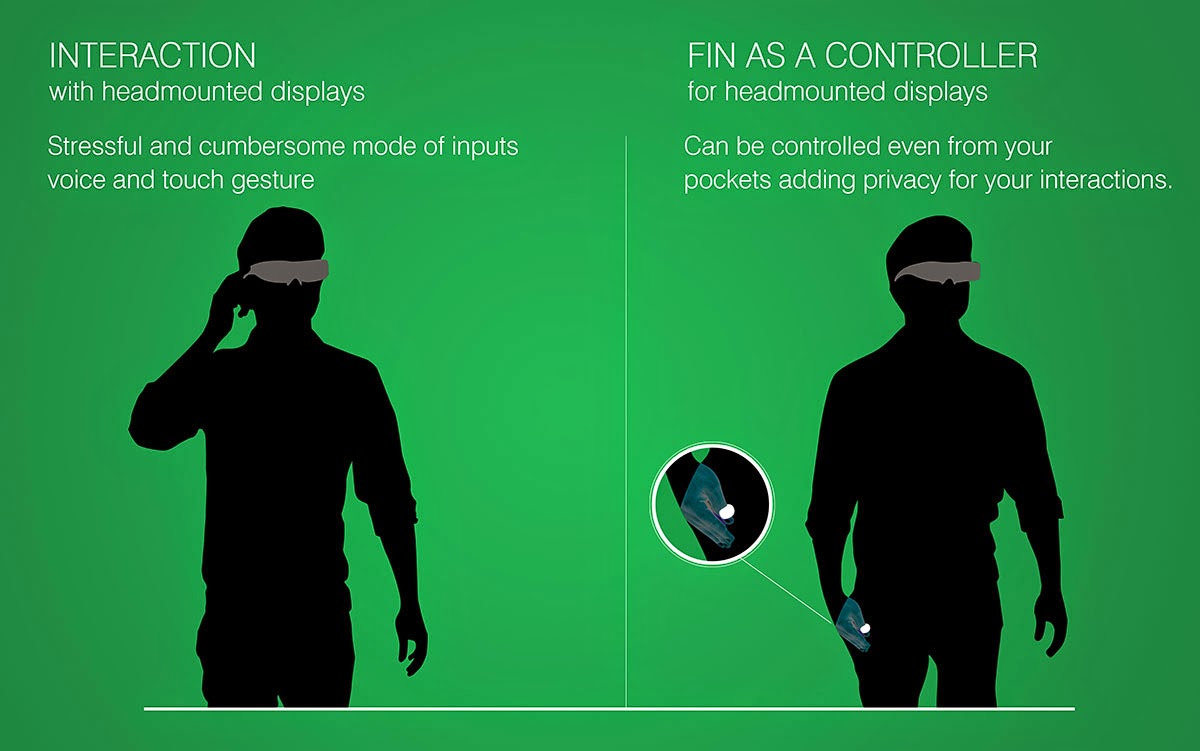
NUI (Natural User Interfaces) This gesture control object will revolutionise the interaction through natural gestures.FIN is a small hardware that users can use as a ring. It is composed by sensors that recognise each segment of the fingers (phalanges): It has bluetooth connectivity that can be used to connect the FIN to other devices like smartphones, TV's or other similar devices wearable.
(Image source: FIN)
You can assign each activities and act like "Hot Keys". Each of your fingers are connected to the devices segments. e.g.: Just tap using the thumb on the segment of the finger to make your phone silent - Mode ON / OFF - while the phone is in your pocket. FIN tiny wearable device wear the thumb of your hand and it will make your whole palm, fingers and numeric keypad a gesture space.
Prototype This is a prototype but the initial initiative of a public funding for the project, was a overwhelming success that managed to raise over $200,000 USD from over 2000 people to develop this invention. "FIN is one of the TOP 15 Startups in the world in TechCrunch Hardware Battlefield 2014 during CES2014 at Las Vegas."
Technology is advancing at such a rate that traditional methods of teaching and learning are not pushing the full potential of both students and teachers. By using it properly inside and outside of the classroom, we can create a new dimension of teaching and learning.
All the students use computers or tablets in their classroom and hobbies. We can find also a wide range of interests outside of each area of study. They use the latest in technology - Computers, smartphones, tablets, mp3 players or digital cameras. They expect that all this "technology" works properly and fast and if not, they get bored. In my opinion, the solution is challenging them properly with creative and innovative ways. They learn by doing, not by reading the instruction manual or only listening some lectures.
Generational differences in learning techniques are normaly in how people of different ages approach technology. We are closer to our grandparents in optimism about the future than our parent's generation. Students get a better grasp of concepts if the professor is trying to teach them by doing with hands-on work. The use of technology only enhances this "hands-on experience", it does not replace human interaction.
Raphael Kluzniok, The Chronicle
3. Cut-and-Paste Culture
Technology is everywhere. The "tech-savviness" and the traditional educational practices and ethics are coming into question. E.g. "cheating", it is a major academic infraction. When I talk to the students about this situation, they tell me that cheating is part of the culture, especially in theoretical disciplines. I have been asking myself if Is it because students aren't learning or it is because their learning and working ethic are different from myself and my colleagues. For me plagiarism is an academic environment is an infraction of choice. How can it not be? Information is easily available trough Internet and scientific papers are being sold online with a simple VPN access. The temptation to do "copy/paste" and pull in quotes from a web site without reference is easy and does not work any. It is necessary to implement discipline of effort, work methods and teamwork since the first day of kindergarten.
(Image source: http://iosguides.net)
4. Access and Skills
I agree that students need to be able to use the technology. The more advanced users are (Know how to write a simple Web page, update a ready-made blog site or even download music and movies—perhaps illegally) more capability they have to deal with technological problems. Technology is expensive and I am afraid that most users have no knowledge about how to set up a local area network or even how to troubleshoot their own computer for small problems. Even though I agree that most technological systems are intuitive, there are certainly users with difficulties. In some school, the students must pass a computer competency test before being promoted to high school. The average is how to use a computer for homework, checking e-mail, online chatting and surfing on the Internet. It would be important for all courses, a basic technological discipline with computer skills beyond fundamentals like digital document archiving, web page design, using html or css, setting up wireless networks or using a firewall. These are "smalls" skills that students need to know to be more competitive.
"On January 24, 1984, Apple introduced the Macintosh. And with it a promise that the power of technology, put in the hands of everyone, could change the world. On January 24, 2014, we sent 15 camera crews all over the world to show how that promise has become a reality. From sunrise in Melbourne to nightfall in Los Angeles, they documented people doing amazing things with Apple products. They shot over 70 hours of footage - all which the iPhone 5. Then it was edited and scored with an original soundtrack. Thanks to the power of the Mac and the innovations it has inspired, an effort that normally takes months was accomplished in a matter of days"
According to the Apple, thirty years ago the Mackintosh put the power of technology in everyone's hands, launching a generation of pioneers who continue to change the world. I still remember the first Mac that I worked, iMac G3 (1998).
IBM believes that the breakthroughs in computing will amplify human abilities because as computers get smarter, they will be integrated in more devices that help us do things when we need them done.
“We try to get a sense of where the world is going because that focuses
where we put our efforts,” Meyerson said. “The harder part is nailing
down what you want to focus on. Unless you stick your neck out and say
this is where the world is going, it’s hard to you can turn around and
say you will get there first. These are seminal shifts. We want to be
there, enabling them.”
Bernie Meyerson, the vice president of innovation at IBM.
"Imagine this: Your computer, the one you carry around in your pocket or
purse, knows everything about you. With your permission, it knows about
your relationships with the people, places and things in your world. It
talks and listens to you. And, as your computer interacts with you and
with the vast store of data about you, it learns to be an even better
assistant—helping you navigate your personal and professional lives."
Steve Hamm, Communications Strategist at IBM "Building a smarter planet" http://asmarterplanet.com/blog/ IBM's prognostications "5 in 5" about technology: This is a list of fiveinnovations forthe next five yearsthat predictthe ways in whichpeople willwork, liveand interact.
1. The classroom will learn you
In five years, cognitive computing will help teachers through using “longitudinal data” to better understand student behavior. The sophisticated data analysis will help them to make decisions about the students which are at risk, know their roadblocks and find a way to help them.
Worldwide last year online sales topped 738.388836 billion Euros. Many physical retailers given up of their business as they fail to compete with Amazon. They need to use the immediacy of the store and the proximity to customers to create experiences that online-only retail can’t replicate.
3. Doctors will use your DNA to keep you well
In five years, doctors will routinely use our DNA to keep us well (IBM believes and so do I). Nowadays, a DNA testing to help make treatment decisions is still rare. Global cancer rates are expected to jump by 75% by 2030 and IBM wants computers help doctors in understanding how a tumor affects a patient down to their DNA.
IBM Research > Health "Goodbye athlete’s foot: IBM researchers craft nanomedicine to kill fungi where other meds fail" http://venturebeat.com/2013/
4. A digital guardian will protect you online
We have multiple passwords, identifications and devices than ever
before and the security across them is highly fragmented. In five years,
IBM envisions a digital guardian that will become trained to focus on
the people and items it’s entrusted with. This smart guardian with a 360
degrees of data about someone, will sort
through contextual, situational and historical data to verify a
person’s identity on different devices.
IBM predicts that cities will digest citizens information freely provided by place resources where they are needed. By 2030, the urban humanity from developed world will grow up 80% and by 2050, seven out of every 10 people will be a city dweller. The only way cities can manage this situation is to have automation, where smarter cities can understand in real-time how billions of events occur as computers learn to understand what people need, what they like, what they do and how they move.
![interfaceanology [Research Notebook]](https://blogger.googleusercontent.com/img/b/R29vZ2xl/AVvXsEh3WFqvy0LL4QjF-EKooupqxtHF24kWqCuyYwAY_baLnW7CFv_wdrULh0Y2yYL0_tk5tDld6x0374oHU3TwcOBp2T_aVQeLTp7_hZFFusxW1roN96igIWHSiSJRiwSSG_1K0mg6FFAbA7Bq/s1600/1.jpg)