9.02.2014

Using technology to improve your health

For me, this is an area of interest - Integrated in technology, user experience and interaction design. Obviously, writing as Crohn's Disease patient since 2002, my ph.d and research work are focus on innovation solutions to improve my and your health.


CUE - Tracking Your Health Information
We can call to these Cue makers a “deep health tracker". Actually it is a tracking of users health on a molecular level (It is similar to the diabetes measuring), rather than more remotely monitoring signals like blood pressure or heart rate.

(Image source: CUE)

The idea for this system came after the founders understand that to much people were flooding the healthcare system wanting to know only whether they had a flu or not, which I considered as an important situation but not an emergency. “All these people were seeking this one piece of information, and we thought that there had to be a much simpler way for people to find out the information without having to stand in a huge emergency room line or wait for a doctor’s appointment”.


Pre-order (Shipping only starts on Spring, 2015) 


HOLIBRAILLE - Helping Blind Users 
In partnership with INESC-ID (Universidade Técnica de Lisboa) and LaSIGE (Departamento de Informática da Universidade de Lisboa), seven researchers were involved with the development of a system that combines chord input with a series of vibrations that notify a blind user of what the system is registering. The HoliBraille case can be attached to a Samsung Android phone and feeds information to the user in the form of vibrations felt through the fingers before the chord is committed and an error has been made, through an Arduino. To talk to the phone case via Bluetooth an open source micro-controller is used. The case then passes the information by activating an individual vibro-tactile motors next to the fingers that make up the chords.


(Image source: TechCrunch)

"Augmenting Braille Input through Multitouch Feedback" (2013)
H. Nicolau, K. Montague, J. Guerreiro, D. Marques, T. Guerreiro, C. Stewart, V. L. Hanson

Abstract
" Current touch interfaces lack the rich tactile feedback that allows blind users to detect and correct errors. This is especially relevant for multitouch interactions, such as Braille input. We propose HoliBraille, a system that combines touch input and multi-point vibrotactile output on mobile devices. We believe this technology can offer several benefits to blind users; namely, convey feedback for complex multitouch gestures, improve input performance, and support inconspicuous interactions. In this paper, we present the design of our unique prototype, which allows users to receive multitouch localized vibrotactile feedback.
 Preliminary results on perceptual discrimination show an average of 100% and 82% accuracy for single-point and chord discrimination, respectively. Finally, we discuss a text-entry application with rich tactile feedback."


PEEKVISION - Portable Eye Examination Kit
The project aims to improve opthalmic health in underdeveloped countries by adapting smartphones with a clip-on hardware and an app. Created by a team of ophthalmologists, developers and engineers, PEEK is a combination of different technologies that can be used by a non-expert with short training to carry out a range of eye-health checks and help prevent and diagnose blindness.
(Image source: Dezeen Magazine)

"By harnessing mobile phone apps, hardware and rigorous scientific testing, we have created an easy to use, affordable and portable system for testing eyes anywhere in the world - from surgeries to patients’ homes".

Designs of The Year 2014 (Technology category) 
http://www.dezeen.com/tag/designs-of-the-year-2014/


The app will be available soon ... 
http://www.peekvision.org

7.27.2014

Kraków with a conference, feelings and a state of mind.

The conference
Between 19th and 25th of July I presented my 2nd scientific paper as a member of UNIDCOM  (http://www.iade.pt/unidcom/) in Kraków on Jagiellonian University. The title is Human-Social Interaction model for e-health Interfaces and it is related with my Ph.D research. If you are a researcher international ou not, please flow me on the Research Gate (The network dedicated to science and research):  https://www.researchgate.net/profile/Claudia_Pernencar?ev=hdr_xprf

AHFE 2014 was wonderful. I met internacional researchers and I have done good contacts. Almost 482 people was there from 50 countries integrated in 12 distinguished international boards. The conference was sponsored by IBM and Elsevier. For me, It was important to better understand about the impact factor of cientific publishing with Taylor & Francis Group.

For more information about the conference: http://www.ahfe2014.org. Next year, will be in Las Vegas, Nevada, USA 26-30 July. The 6th international Conference on Applied Human Factors and Ergonomics.


The City of Kraków
Kraków with almost 853,000 inhabitants, is a city located on Poland south, in the margins of the river Vistula with attractive places to see. It was founded around by the year 700. This city was devastated by Mongols in 1241,1259 and 1287. It has been integrated in Austria and acquired the name of Krakow in 1914. The historical center was inscribed by UNESCO in 1978 Patrimony of the World list. It is a safety city, so we can use public transport even at night. Walking around it is another solution, in my opinion, one of the best to understand the local culture and the details.


Kraków details


The Jewish quarter


One of my interests since a few years ago, has been the Jewish culture. I started to see the Jewish Museum in Berlim last year and in Poland, another Jewish Museum. Both are different but complement themselves.

Jewish Museum Berlin http://www.jmberlin.de
The permanent exhibition “Two Millennia of German Jewish History“ presents Germany through the eyes of the Jewish minority.This based on the people who have directed with the development of the museum as well as personalities of public life who are dedicated to intercultural understanding and have been honored with the Jewish Museum's Prize for Understanding and Tolerance. In three buildings we can found two millennia of German-Jewish history are on display in the permanent exhibition as well as in various changing exhibitions.

Jewish Museum Poland http://www.en.galiciajewishmuseum.org

This is more a contemporary look at the Jewish past in Poland. It is to commemorate the victims of the Holocaust and to celebrate the Jewish culture of Polish Galicia, presenting the Jewish history from a different perspective.


Rural Kraków 
On the way to Auschwitz I had the opportunity to contact the more rural side of the country. Almost all the houses I passed were well estimated, with large gardens and animals in the wild to get along with others from dogs, chickens, jumper, ducks, among others.


Auschwitz 
"In the years 1940-1945, the Nazis deported at least 1300.000 people to Auschwitz: 1100.000 Jews; 150.000 Poles; 23.000 Gypsies; 15.000 Soviet prisoners of war; 25.000 Prisoners from other ethnic groups." The visit worth by the experience and the local hypothesis of realising the horrors passed there, reliving the memory of so many films that create the atmosphere of the dorms, prisons and the outside dry. In my opinion, the museum does not make the justice to the memory of the victims, I think due to some conservatism in transforming the business in a historical product.


Kraków flavors 
Poland is a country at the crossroads of European trade routes where the melting pot of cultures, religions and traditions are embeded. I read in Trip Advisor that was one of the best country in Europe for bread, bigos, white and red Żurek barszcz, Pierogi, Baltic herring and highland sheep's cheese but our choise was Ukrainian Food.

The most famous main course is a table of the Ukrainian is the Red Borscht soup (3th picture). It is served with garlic bread and a glass of horilka. Horilka is Ukrainian vodka but we ordered beer (2nd Picture). I think we eat Salo with potatos (4th Picture) but I'm not shure. Salo is a product made of pork, a side of him is with skin.


4.22.2014

No limits for Natural Gestures with FIN

NUI (Natural User Interfaces)
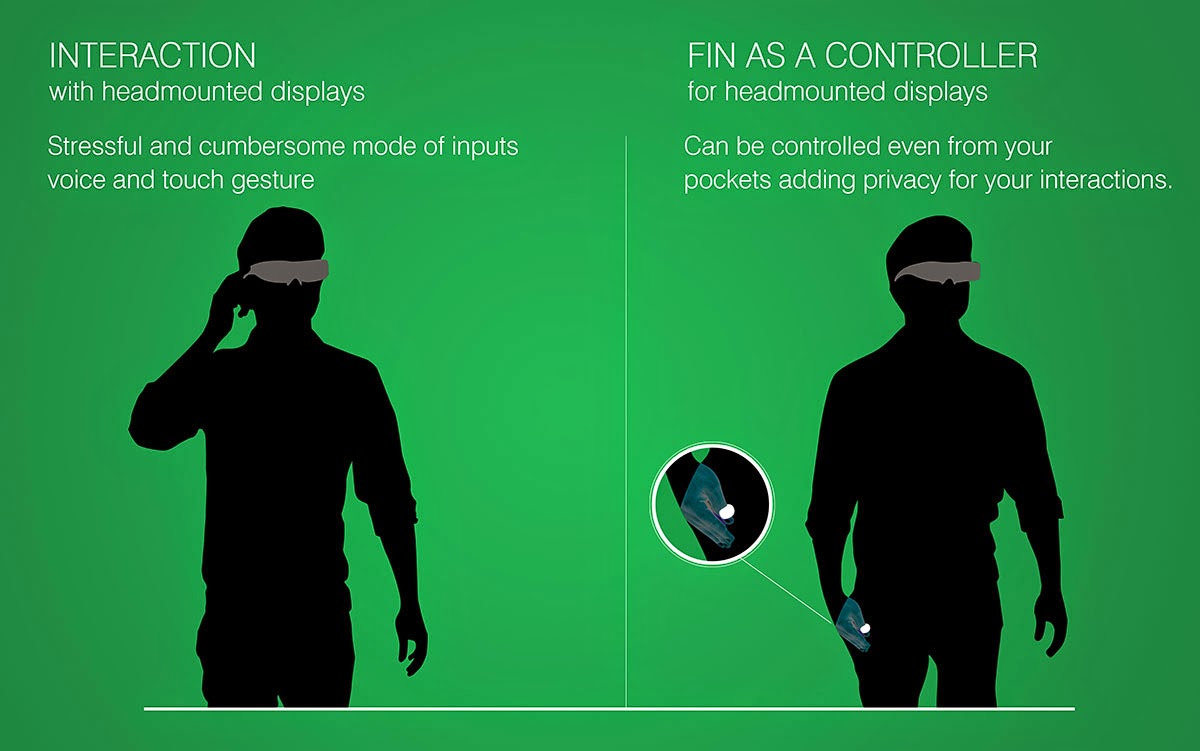
This gesture control object will revolutionise the interaction through natural gestures.  FIN is a small hardware that users can use as a ring. It is composed by sensors that recognise each segment of the fingers (phalanges): It has bluetooth connectivity that can be used to connect the FIN to other devices like smartphones, TV's or other similar devices wearable. 

(Image source: FIN)

You can assign each activities and act like "Hot Keys". Each of your fingers are connected to the devices segments. e.g.: Just tap using the thumb on the segment of the finger to make your phone silent - Mode ON / OFF - while the phone is in your pocket. FIN tiny wearable device wear the thumb of your hand and it will make your whole palm, fingers and numeric keypad a gesture space.

Image source: Indiegogo

Image source: Indiegogo

Pre-order
http://www.wearfin.com


Prototype
This is a prototype but the initial initiative of a public funding for the project, was a overwhelming success that managed to raise over $200,000 USD from over 2000 people to develop this invention. "FIN is one of the TOP 15 Startups in the world in TechCrunch Hardware Battlefield 2014 during CES2014 at Las Vegas." 


3.15.2014

Growing Up with Technology

Technology is advancing at such a rate that traditional methods of teaching and learning are not pushing the full potential of both students and teachers. By using it properly inside and outside of the classroom, we can create a new dimension of teaching and learning.

Original source (nytimes.com): Fast times at woodside high  
1. Learning by Doing
All the students use computers or tablets in their classroom and hobbies. We can find also a wide range of interests outside of each area of study. They use the latest in technology - Computers, smartphones, tablets, mp3 players or digital cameras. They expect that all this "technology" works properly and fast and if not, they get bored. In my opinion, the solution is challenging them properly with creative and innovative ways. They learn by doing, not by reading the instruction manual or only listening some lectures. 

Geoff Mulgan: A short intro to the Studio School

2. Human Interaction, not Isolation

Generational differences in learning techniques are normaly in how people of different ages approach technology. We are closer to our grandparents in optimism about the future than our parent's generation. Students get a better grasp of concepts if the professor is trying to teach them by doing with hands-on work. The use of technology only enhances this "hands-on experience", it does not replace human interaction. 

 Raphael Kluzniok, The Chronicle 

3. Cut-and-Paste Culture
Technology is everywhere. The  "tech-savviness" and the traditional educational practices and ethics are coming into question. E.g. "cheating", it is a major academic infraction. When I talk to the students about this situation, they tell me that cheating is part of the culture, especially in theoretical disciplines. I have been asking myself if Is it because students aren't learning or it is because their learning and working ethic are different from myself and my colleagues. For me plagiarism is an academic environment is an infraction of choice. How can it not be? Information is easily available trough Internet and scientific papers are being sold online with a simple VPN access.

The temptation to do "copy/paste" and pull in quotes from a web site without reference is easy and  does not work any. It is necessary to implement discipline of effort, work methods and teamwork since the first day of kindergarten.

(Image source:  http://iosguides.net)

4. Access and Skills
I agree that students need to be able to use the technology. The more advanced users are (Know how to write a simple Web page, update a ready-made blog site or even download music and movies—perhaps illegally) more capability they have to deal with technological problems.

Technology is expensive and I am afraid that most users have no knowledge about how to set up a local area network or even how to troubleshoot their own computer for small problems. Even though  I agree that most technological systems are intuitive, there are certainly users with difficulties.

In some school, the students must pass a computer competency test before being promoted to high school. The average is how to use a computer for homework, checking e-mail, online chatting and surfing on  the Internet. It would be important for all courses, a basic technological discipline with computer skills beyond fundamentals like digital document archiving, web page design, using html or css, setting up wireless networks or using a firewall. These are "smalls" skills that students need to know to be more competitive.